

When it comes to SEO, the old saying 'you can't have your cake and eat it too' couldn't be more fitting. Balancing the various elements of search engine optimization is a delicate act that requires finesse and strategy.
From keywords and content to on-page and off-page factors, the list of considerations can seem endless.
But fear not, because finding the right equilibrium is not only possible but essential for driving organic traffic and maximizing your online presence.
So, are you ready to uncover the key to navigating this intricate web and achieving SEO success?
Keywords and Content
To maximize the effectiveness of your website's SEO, integrating relevant keywords seamlessly into your content is essential for boosting visibility and driving organic traffic.
This process begins with thorough keyword research and competitor analysis to understand what terms your audience is searching for and how your competitors are approaching them.
Once you have identified the most valuable keywords, it's crucial to strategically incorporate them into your content while ensuring it remains natural and valuable to the reader.
Content optimization goes hand in hand with keyword integration, focusing on user intent to provide information that aligns with what users are seeking.
Quality and Quantity
When it comes to balancing SEO, it's crucial to consider both the quality and quantity of your content.
Finding the right mix of high-quality, valuable content and a sufficient quantity of it's essential for SEO success.
Additionally, ensuring diversity in your backlink profile and the types of content you produce can further boost your site's visibility and authority.
Content Balance
Achieving the right balance between the quality and quantity of your content is essential for effective SEO. When it comes to content balance, it's crucial to focus on both visual content and user experience. Here's how you can achieve this:
- Visual Content: Incorporating high-quality images, videos, and infographics into your content can enhance user engagement and make your website more visually appealing.
- User Experience: Prioritize creating content that provides value to your audience and ensures a seamless user experience. This includes easy navigation, clear formatting, and relevant, informative material.
- Quality Over Quantity: While it's important to have a consistent flow of content, quality should never be compromised for quantity. Always prioritize creating valuable, well-researched content that resonates with your audience.
Link Diversity
Fostering a diverse array of high-quality links is crucial for enhancing your website's SEO performance. When it comes to backlinks, focus on obtaining them from a variety of reputable sources with different domain authorities. This won't only improve your website's authority but also drive more referral traffic.
Incorporating diverse anchor text in your backlinks is equally important. Using a mix of branded, exact match, and partial match anchor text helps search engines understand the context of the linked page.
Quality should always be prioritized over quantity when building backlinks. Keep in mind that search engines value natural and organic link-building practices.
On-Page and Off-Page
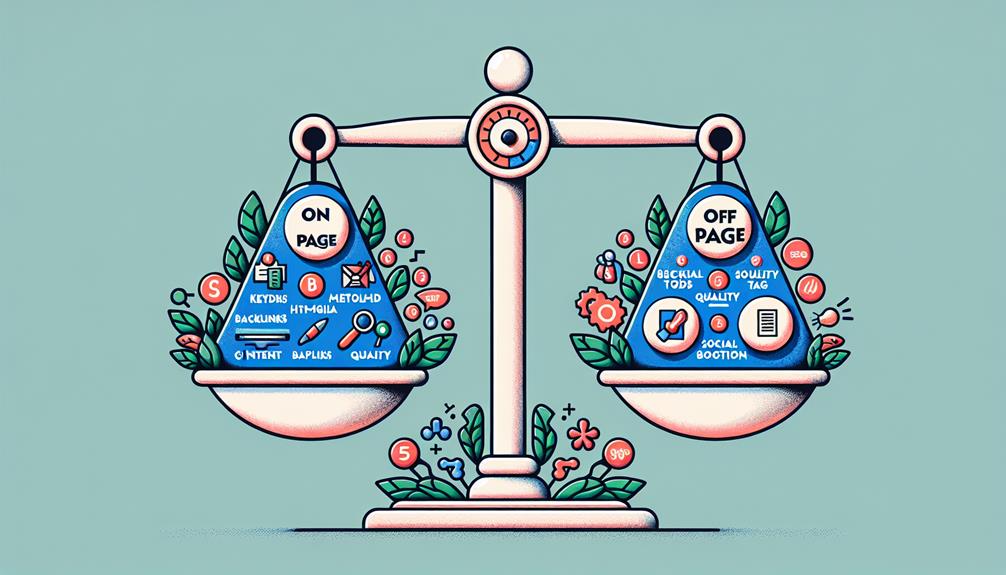
Now let's talk about the essential aspects of on-page and off-page SEO.
On-page basics focus on optimizing individual web pages to rank higher and earn more relevant traffic.
Off-page strategies, on the other hand, involve activities outside of your website to boost its authority and improve its search engine rankings.
On-Page Basics
Understanding the fundamentals of on-page and off-page SEO is crucial for optimizing your website's visibility and ranking in search engine results.
When focusing on on-page basics, there are several key elements to consider:
- Meta Tags and Headings: Crafting relevant meta tags and using proper headings (H1, H2, etc.) helps search engines understand the context of your content.
- Image Optimization and Internal Linking: Optimizing images with descriptive filenames and alt text, and strategically implementing internal links within your content, can enhance user experience and improve SEO.
- Quality Content Creation: Creating high-quality, relevant, and valuable content for your audience is essential for on-page SEO success.
Off-Page Strategies
When optimizing your website, implementing off-page strategies is crucial for improving your search engine ranking and increasing your online visibility. Utilizing social media platforms to engage with your audience and share valuable content can significantly impact your off-page SEO.
Actively participating in social media communities, sharing blog posts, and interacting with followers can enhance your website's authority and drive traffic.
Additionally, influencer marketing can be a powerful off-page strategy to boost your brand's visibility. Collaborating with influencers in your industry can help increase your brand awareness and attract new audiences to your website.
Relevance and Authority
To achieve high rankings in search engine results, it's essential to ensure that your content is both relevant and authoritative. Here's how you can achieve this:
- User Engagement: Encourage interaction with your content through comments, shares, and likes. Engaged users signal to search engines that your content is valuable and relevant.
- Social Signals, Influencer Outreach: Leverage social media platforms to increase visibility and reach. Connect with influencers in your industry to gain credibility and authority.
- Quality Backlinks: Seek out reputable websites to link back to your content. Quality backlinks from authoritative sites can significantly boost your content's credibility and relevance.
Speed and Performance

Hey there!
When it comes to SEO, speed and performance are crucial factors that can make or break your website's success. Page load time and mobile optimization play a significant role in determining your site's ranking on search engine results pages.
Ensuring that your website is fast and optimized for mobile devices is essential for attracting and retaining visitors.
Page Load Time
Improving your website's page load time significantly impacts user experience and search engine rankings. To achieve this, consider the following:
- Browser caching: Utilize browser caching to store webpage resources, such as CSS files, JavaScript, and images, which allows for quicker loading on subsequent visits.
- Responsive design: Ensure your website is designed to be responsive, adapting to various devices and screen sizes, which can enhance the overall user experience and decrease load times.
- Image optimization: Compress and optimize images to reduce file sizes without compromising quality, leading to faster load times and improved user experience.
Mobile Optimization
For a seamless user experience and improved search engine rankings, optimizing your website for mobile speed and performance is essential.
User experience and design play a crucial role in ensuring that your website is responsive and loads quickly on mobile devices.
Slow page speed can lead to high bounce rates and negatively impact your site's visibility in search results.
To enhance mobile optimization, focus on reducing image sizes, leveraging browser caching, and minimizing server response times.
Additionally, prioritize responsive web design to ensure that your site adapts to various screen sizes and orientations.
Mobile and Desktop
When optimizing your website for both mobile and desktop platforms, consider the unique user experiences and behaviors associated with each.
Mobile usability and user experience play a crucial role in engaging mobile users. Responsive design is essential for ensuring that your website adapts seamlessly to different screen sizes, providing a consistent user experience across devices.
Additionally, with mobile-first indexing becoming increasingly important for search engines, prioritizing mobile optimization is key to improving your website's search rankings.
However, desktop users still make up a significant portion of your audience, so ensuring that your website is also optimized for desktop usage is essential for providing a comprehensive user experience.
Balancing the needs of both mobile and desktop users will help you reach a wider audience and improve your overall SEO performance.
Organic and Paid

To enhance your website's visibility and reach, it's crucial to understand the distinction between organic and paid search strategies.
Organic search involves optimizing your website to rank higher in search results naturally, without paying for placement.
On the other hand, paid search includes ad targeting and ad placement, where you pay to have your website displayed at the top of search engine results for specific keywords. With paid search, you have more control over ad placement and can target specific audiences based on demographics, interests, and behaviors.
Additionally, conversion tracking and budget management are essential aspects of paid search, allowing you to monitor the effectiveness of your ads and adjust your budget allocation to maximize returns.
Long-Tail and Short-Tail
As you consider balancing your SEO strategies, it's important to understand the distinction between long-tail and short-tail keywords and how they impact your website's visibility and reach.
Long-tail keywords are more specific and target niche audiences, while short-tail keywords are broader and often more competitive.
Here's what you need to know:
- Keyword Research: Long-tail keywords require thorough keyword research to identify specific phrases that align with user intent.
- Competition Analysis: Short-tail keywords typically have higher competition, making it essential to conduct in-depth competition analysis to identify opportunities.
Analytics and Intuition

Considering the complex landscape of SEO, your website's success relies on a harmonious blend of analytics and intuition to drive impactful decision-making and optimization strategies.
Data analysis plays a crucial role in understanding how users interact with your website. By utilizing tools such as Google Analytics, you can gain valuable insights into user behavior, popular content, and traffic sources. This data empowers you to make informed decisions about which SEO strategies are most effective in improving the user experience.
However, it's equally important to balance this data-driven approach with intuition. Your intuition, honed through experience and industry knowledge, can guide you in making intuitive adjustments that may not be immediately evident from the data alone.
Consistency and Adaptability
Balancing your website's success with a harmonious blend of analytics and intuition involves maintaining consistency and adaptability in your SEO strategies.
Consistency is crucial for establishing a strong online presence, while innovation and adaptability are equally important for staying ahead in the ever-evolving digital landscape. Here's how to achieve this balance:
- Consistency: Regularly publishing high-quality content and maintaining a cohesive brand voice across all platforms establishes trust and authority with both users and search engines.
- Innovation: Embracing new SEO trends, technologies, and strategies allows you to stay competitive and relevant in the dynamic digital environment.
- Adaptability and Flexibility: Being open to adjusting your approach based on performance data and industry shifts ensures that your SEO efforts remain effective and impactful.
Frequently Asked Questions
How Can I Balance the Need for Quality Content With the Quantity of Content Required for Seo?
Balancing quality content with the quantity needed for SEO involves prioritizing user engagement and keyword density. Focus on creating valuable, relevant content that resonates with your audience while strategically incorporating keywords to enhance SEO performance.
What Are Some Strategies for Balancing On-Page and Off-Page SEO Efforts?
To balance on-page and off-page SEO, focus on keyword research, content optimization, and link building for a strong website foundation. Then, harness social media for off-page efforts. Striking this balance will boost your site's visibility and credibility.
How Do I Determine the Right Balance Between Relevance and Authority in My SEO Strategy?
To determine the right balance between relevance and authority in your SEO strategy, start with thorough keyword research and competitor analysis. Then focus on effective link building and engaging in social media to boost your website's authority and relevance.
What Are Some Ways to Balance the Speed and Performance of My Website With SEO Optimization?
To balance the speed and performance of your website with SEO optimization, focus on improving user experience. Streamline code, optimize images, and leverage browser caching. Prioritize website speed optimization for better rankings and happier visitors.
How Can I Balance the Needs of Mobile and Desktop Users in My SEO Efforts?
Balancing the needs of mobile and desktop users in your SEO efforts is crucial for a seamless user experience. Prioritize responsive design, intuitive navigation, and high-quality content optimization to cater to both audiences effectively.
Conclusion
So, when it comes to SEO, it's all about finding the right balance.
Did you know that 75% of users never scroll past the first page of search results?
That's why it's crucial to balance keywords and content, quality and quantity, on-page and off-page optimization, and so much more.
By finding the right balance, you can improve your website's visibility and drive more organic traffic.
Keep these factors in mind as you continue to optimize your site for search engines.